7th Class English(jasmine) - Chapter-2 Try Again All Question With Answer
↓ Question & Answer ↓
I. Who inspires you to do your best?
Answer:
My parents inspire me to do my best.
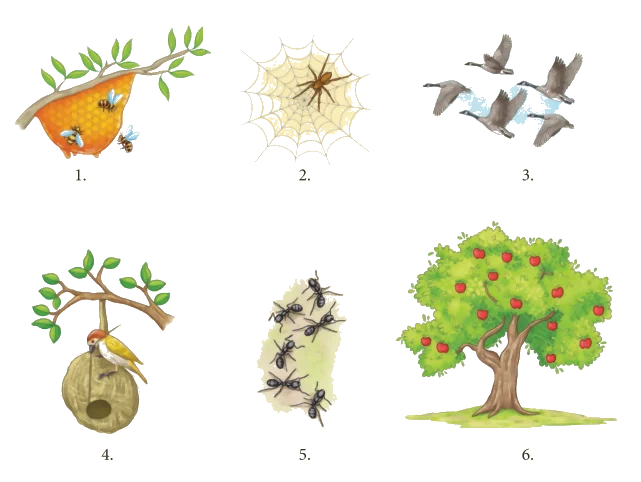
II. Work in pairs, identify what you see in the pictures given below. What can we learn from them? Share your answers with your classmates and the teacher.
Answer:
Image 1 : shows a beehive attached to a tree branch, with bees actively working around it. We should learn to work hard like bees as they work tirelessly to build their hive and collect nectar. Even when obstacles arise, they never give up. They also show teamwork by creating a hive together.
Image 2 : shows a spider in its web, symbolising patience and perseverance.. We can learn hard work, determination, and never giving up despite failures.
Image 3 :shows a flock of birds flying in the sky which teaches us teamwork and unity. They show that working together and supporting each other helps in achieving great distances and success.
Image 4 :shows a bird building its nest which teaches us patience and dedication, as it carefully creates a safe space for its future. It reminds us that success comes from small, consistent efforts.
Image 5: shows a colony of ants which teaches us the power of collaboration and hard work, as each ant contributes to the collective success. It shows that even the smallest efforts can create something remarkable when combined.
Image 6 :shows a tree with apples which teaches us the value of patience and growth, as it takes time to bear fruit. It reminds us that with nurturing and care, rewards eventually come.

The poem, written in a narrative style, tells the story of King Bruce of Scotland, who was feeling 1. _____________ after failing multiple times to achieve something 2. _____________ for his people. In a moment of 3. _____________, he observed a spider trying to reach its web high above. The spider 4. _____________ every time it fell after getting close to its goal. It made nine 5. _____________ and fially succeeded. The king said that the spider had 6. _____________ and so would he. Inspired by the spider’s determination, King Bruce decided to 7. _____________. When he 8. _____________ this time, he ultimately succeeded.
Answer:
The poem, written in a narrative style, tells the story of King Bruce of Scotland, who was feeling 1.low after failing multiple times to achieve something 2. great for his people. In a moment of 3. despair he observed a spider trying to reach its web high above. The spider 4. mounted every time it fell after getting close to its goal. It made nine 5.attempts and finally succeeded. The king said that the spider had 6.conquered and so would he. Inspired by the spider’s determination, King Bruce decided to 7. strive. When he 8. tried this time, he ultimately succeeded.
The central idea of the poem is ________.
Answer:
The central idea of the poem is perseverance and determination
Question 1.
lines that describe the spider’s efforts
Answer:
Following are three lines from the poem that describe the spider’s efforts:
(a) “It soon began to cling and crawl, Straight up with strong endeavour” -This shows the spider’s determination to climb.
(b) “Again it fell and swung below, But again it quickly mounted” – This highlights how the spider kept trying despite failing.
(c) “Steadily, steadily, inch by inch, Higher and higher he got” – This describes the spider’s slow but persistent effort to reach its web.
Question 2.
alliteration (the repetition of the same consonant sounds at the beginning of closely connected words)
Answer:
Following are three examples of alliteration from the poem:
(a) “Fast, now slow” – The repetition of the ‘s’ sound in “slow” and T sound in “fast”.
(b) “Bravo, bravo!” – The repetition of the ‘b’ sound.
(c) “Foolish thing will strive” – The repetition of the ‘s’ sound in “strive” and ‘f sound in “foolish”.
Answer:
The poet repeats the words and phrases “tried and tried; steadily, steadily; up, up” to emphasise persistence, determi¬nation, and continuous effort respectively. By using repetition, the poet makes the message of never giving up stronger.
1. He flung himself down in low despair,
As grieved as man could be;
And after a while he pondered there,
“I’ll give it all up, ” said he.Now just at that moment a spider dropped, With its silken, filmy clue;
(i) Select the phrase which shows the physical expression of the King’s emotional state.
Answer:
The phrase that shows the physical expression of the King’s emotional state is:
“He flung himself down in low despair.”
(ii) The poet has used the word 'low before despair'What doesthe word ‘low’ mean here ?
Answer:
The poet uses the word low’ before ‘despair’ to emphasise the depth of King Bruce’s sadness and hopelessness.
It highlights that he was not just feeling discouraged but had reached a deep emotional and mental low, almost giving up completely.
(iii) Choose the correct option to complete the sentence.
In the line, ‘And after a while he pondered there’, the word ‘pondered’ means ________.
A. paused
B. thought
C. noticed
D. rested
Answer:
B. thought.
(iv) Choose the correct option from the words given in the brackets.
The phrase ‘silken filmy clue’ creates an image of something that is ________ (long and light/very delicate and soft).
Answer:
very delicate and soft.
(i) Choose the correct option to complete the analogy.
toil: hard :: ________ : ________.
A. roll: tumble
B. tumble: circle
C. compress: roll
D. jump: tumble
Answer:
A. roll: tumble.
(ii) List any two characteristics of the spider highlighted in the line, ‘But up the insect went once more’.
Answer:
Two characteristics of the spider highlighted in the line “But up the insect went once more” are:
1. Perseverance* – The spider does not give up despite repeatedly falling; it keeps trying again and again.
2. Determination – It is committed to reaching its goal and continues climbing despite difficulties.
(iii) Choose the correct option to complete the sentence.
The expression ‘Ah me!’ in the extract indicates a sense of ________.
A. happiness
B. stress
C. relief
D. loneliness
Answer:
B. stress.
(iv) Complete the sentence with an appropriate reason.
Readers are able to relate to this extract because_____________________ .
Answer:
It reflects real-life struggles, where people face failures but must keep trying with perseverance and determination to achieve success.
Question 1.
How does the first stanza help in setting the mood of the poem?
Answer:
This stanza helps in setting the mood of the poem by preparing the reader for the king’s journey of struggle and eventual determination as it is portraying a sense of sadness, disappointment of the King.
Question 2.
Describe how King Bruce’s attitude changes from the beginning towards the end of the poem.
Answer:
At the beginning of the poem, King Bruce felt defeated, hopeless, and discouraged. Despite being a monarch, he is deeply troubled because he has tried multiple times to accomplish a great deed for his people but has failed repeatedly. This leaves him feel lonely, sad, and in despair. At his lowest point, he even considers giving up entirely.
However, when he observes the spider, his perspective begins to change. He watches as tfie spider struggles but refuses to quit, making nine brave attempts before finally succeeding. Initially, the king doubts the spider and assumes it will give up, but when it keeps climbing and finally wins, his attitude shifts. He feels inspired and motivated, realising that persistence* leads to success.By the end of the poem, King Bruce regains his courage and determination. He decides to try once more, and this time, he succeeds.
Question 3.
The poet describes every action of the spider in great detail. What does this tell us about his attitude towards the spider?
Answer:
The poet’s detailed description of every action of the spider shows his deep admiration, curiosity and respect for its perseverance and determination. Instead of dismissing the tiny creature, the poet carefully observes its struggles and repeated attempts to climb back to its web.
Question 4.
How does the spider inspire us to overcome despair and not give up?
Answer:
The spider’s actions teach us that failure is not the end, but rather a step towards success, and that we must stay determined, work hard, and never give up in life.
Question 5.
The poem teaches us that failures are stepping stones to success. Explain.
Answer:
The poem teaches us that failures are stepping stones to success by showing how both the spider and King Bruce face repeated failures but ultimately achieve their goals through perseverance. It conveys the message that true winners are those who never give up.
Question 6.
The spider’s journey tells us that anyone can be a source of inspiration in our lives. Elaborate.
Answer:
The spider’s journey in the poem teaches us that anyone or anything can inspire us, no matter how small they are.
1. Inspiration can come from anywhere – King Bruce, a great ruler, feels sad and hopeless, but he learns a lesson from a tiny spider.
2. Actions can teach us – The spider keeps trying even after failing many times. This shows us that never giving up leads to success.
3. Even small things can be role models – We usually look up to great people for inspiration, but the poem shows that even a little spider can teach an important life lesson.
4. Keep trying, no matter what – The spider falls many times but does not stop. In the end, it succeeds, just like King Bruce does when he tries again.
Answer:
1. up × down
2. fast × slow
3. glad × sad
4. win × lose
5. succeed × fail
(i) Please make every endeavour to arrive on time.
(ii) Ants toil tirelessly to save food for rainy season.
(iii) We encourage all students to strive to do their best.
(iv) The sailors braced themselves against the strong wind.
Answer:
Here are the correct meanings of the underlined words and sentences using them:
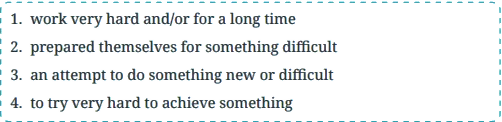
1. Endeavour: An attempt to do something new or difficult
Sentence: Rohan’s endeavour to learn a new language was successful.
2. Toil: Work very hard and/or for a long time
Sentence: Farmers toil in the fields all day to grow crops.
3. Strive: To try very hard to achieve something
Sentence: Students must strive to achieve their dreams with hard work.
4. Braced: Prepared themselves for something difficult
Sentence: The team braced themselves for a tough competition.
Answer:
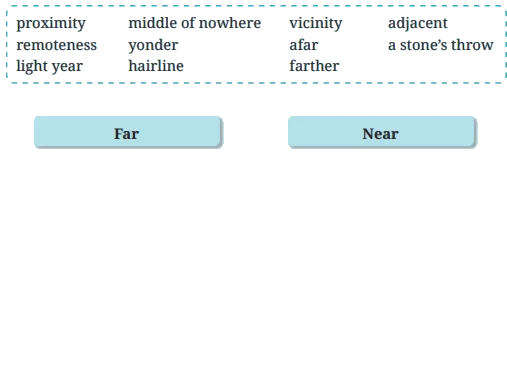
| FAR | NEAR |
|---|---|
| Middle of nowhere | Proximity |
| Remoteness | Vicinity |
| Yonder | Adjacent |
| Afar | A stone’s throw |
| Farther | Hairline |
| Light year |
Question 1.
What was the ant known for?
(i) determination
(ii) strength
(iii) wisdom
Answer:
(i) determination
Question 2.
Why was the ant unable to take the roti home?
(i) It was stuck under a rock.
(ii) It was too heavy to carry.
(iii) It was pulled by other ants.
Answer:
(ii) It was too heavy to carry.
Question 3.
What was the bird doing?
(i) playing with the ant
(ii) searching for food
(iii) picking up leaves
Answer:
(iii) picking up leaves
Question 4.
How did the bird make the ant feel?
(i) proud
(ii) inspired
(iii) relaxed
Answer:
(ii) inspired.
Question 5.
How did the fellow ants help?
(i) by advising the ant continuously.
(ii) by standing still near the ant.
(iii) by joining the ant in her efforts.
Answer:
(iii) by joining the ant in her efforts.
Answer:
Do it yourself.
Narrate a personal experience about a time when you were motivated by some¬one or something to carry on and never give up. Your perseverance helped you.
Use the following sentence prompts as a guide for your narration. Use as per your topic.
1. Introduction:
I remember a time when ………
I felt like giving up. It was when…
There was a moment in my life when
I faced a big challenge. It happened when…
2. Describe the challenge:
The challenge I faced was…
I was struggling with…
The problem seemed too big because …
3. Feeling disheartened:
At first, I felt discouraged and thought about giving up because…
I didn’t think I could succeed because …
I felt upset and wanted to leave because…
4. The source of motivation:
But then, I saw/heard/read about…
Someone/something inspired me to keep going. It was…
I remembered the poem… do not quit…
5. Taking action:
After feeling inspired, I decided to…
I gathered my strength and…
With a new sense of willpower, I…
I asked for help from…
6. The result:
In the end, I was able to…
Thanks to standing firm and never giving up, I achieved…
I felt proud because …
It was worth it because …
7. Reflection:
This experience taught me that…
I learned that perseverance is the key to success…
Now, I always remember to…
The lesson I learnt from this is…
Answer:
Never Give Up – My Experience
I remember a time when I felt like giving up. It was when I was preparing for my math exam. I had always struggled with math, and no matter how much I practiced, I kept making mistakes.
The challenge I faced was understanding algebra. The equations and formulas seemed confusing, and I kept getting the wrong answers. The problem seemed too big because the exam was only a week away, and I felt like I would never improve.
At first, I felt discouraged and thought about giving up because I was afraid of failing. I didn’t think I could succeed because I had already tried many times and still wasn’t getting it right. I felt upset and wanted to leave rpy books aside.
But then, I saw a motivational video about a famous scientist who failed many times before succeeding. It reminded me that mistakes are part of learning. My teacher also told me, “The key to success is to keep trying.” That inspired me to continue working hard instead of giving up.
After feeling inspired, I decided to practice every day, even if I got the answers wrong. I gathered my strength and asked my teacher and friends for help. With a new sense of willpower, I broke the problems into small steps and practiced patiently.
In the end, I was able to understand algebra and solve the problems correctly.
Thanks to standing firm and never giving up, I passed my exam with good marks. I felt proud because I didn’t quit, and my efforts paid off.
This experience taught me that perseverance is the key to success. I learned that failing is okay as long as you keep trying. Now, I always remember to stay determined and never give up, no matter how hard something seems.
Answer:
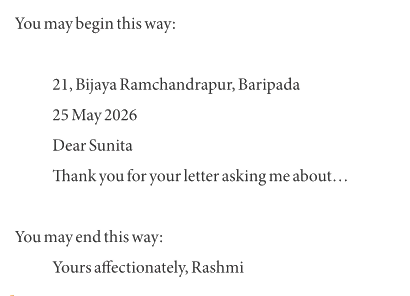
20,Bijaya Ramchandrapur,baripada
23 August 2025
Dear Sunita,
Thank you for your letter asking me about how I deal with difficult situations. I recently read a poem about King Bruce and the Spider, which taught me an important lesson about never giving up. It made me think about the steps I can take to overcome challenges in my life.
To begin with, I remind myself that every problem has a solution, and I should stay calm instead of panicking. Next, I try to understand the problem properly and think of possible ways to solve it. After that, I break the problem into smaller parts and tackle each one step by step. Then, I seek help from my parents, teachers, or friends if I need guidance. Finally, I keep trying without losing hope, just like the spider in the poem.
I want you to remember this too, Sunita—never give up, no matter how hard things seem! Success comes to those who keep trying. If you ever face a tough time, just follow these steps, and you will overcome it. Stay positive and keep believing in yourself!
Looking forward to your reply.
Yours affectionately
Rashmi