7th Class English(jasmine) - Chapter-3 Three Days to See All Question With Answer
↓ Question & Answer ↓
. Work in pairs. Recall a visit to a place that you liked. Discuss the details of that place and write about the following:
Suggestive answers:
Question 1.
Name of the place:
Answer:
Qutub Minar.
Question 2.
The Person(s) you went with
Answer:
Family.
Question 3.
The things that you could:
- See
- listen
- smell
- taste
- touch and feel.
Answer:
- See: The towering Qutub Minar, intricate carvings, lush green gardens.
- Listen: Echoes of footsteps, birds chirping, tour guides speaking.
- Smell: Fresh grass, the earthy scent of stone.
- Taste: Snacks from the local vendors (like roasted peanuts).
- Touch and feel: The cool surface of the monument’s stones, the texture of the grass.
II. How does this memory make you feel?
Answer:
It feels awe-inspiring and peaceful. I enjoyed learning about history while spending quality time with my family.
III. Do you think your visit/experience would be different if you could not see or hear? Share your answers with your classmates and the teacher.
Did you know that our five senses are essential for us to experience and make sense of the world around us?
Answer:
Yes, without sight, I might have relied more on touch and sound to experience the monument. Without hearing, I would have missed the fascinating stories shared by the guides.
Yes, I now understand that our five senses are must for all of us to enjoy living.
I. Work in pairs. Identify the statements that are true from the ones given below. Share your answers with the teacher.
Question 1.
The author expresses a deep longing to experience the world through the sense of hearing.
Answer:
False:
The author expresses a deep longing to experience the world through the sense of sight, not hearing.
Question 2.
The author would like exploring the city only to observe how people are suffering.
Answer:
False:
The author explores the city to observe various aspects of people’s lives, including smiles, determination, and suffering, not just suffering.
Question 3.
The author would spend the first day seeing the people whose kind-heartedness and friendship have enriched her life.
Answer:
True:
The author explicitly mentions spending the first day seeing the people whose kindness and companionship have made her life worth living.
Question 4.
The author acknowledges that even in three days, she would not be able to see everything.
Answer:
True:
The author acknowledges that even in three days, she would not be able to see everything she wanted to.
Question 5.
The author feels that everyone can find the greatest joy merely by the sensg of touch.
Answer:
False:
While the author finds joy in touch, she believes sight must be the most delightful sense.
Question 6.
The author advises those who can see to appreciate every moment as if they might lose their senses tomorrow.
Answer:
True:
The author advises those who can see to appreciate every moment as if they might lose their senses tomorrow.
Question 7.
On the third day, the author would like to observe people in their daily lives and understand their experiences.
Answer:
True:
On the third day, the author observes people in their daily lives to understand their experiences.
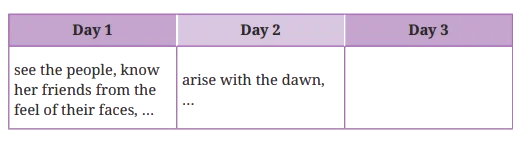
Answer:
| Day 1 | Day 2 | Day 3 |
| See the people, know her friends from the feel of their faces, whose kindness and companionship have enriched her life. | Arise with the dawn; observe the transformation of night into day; visit museums to see Earth’s history and man’s progress. | Observe people in their daily lives; understand their experiences by sight; explore the workaday world. |
I. Read the extracts given below and answer the questions that follow.
Question 1.
I feel the delicate symmetry of a leaf. I pass my hands lovingly about the smooth skin of a silver birch, or the rough, shaggy bark of a pine. In spring, I t0uch the branches of trees hopefully in search of a bud, the first sign of awakening Nature after her winter’s sleep. Occasionally, I am very fortunate; I place my hand gently on a small tree and feel the happy quiver of a bird in full song.
(i) What does the ‘delicate symmetry of a leaf symbolise?
Answer:
The delicate symmetry of a leaf symbolises harmony, balance and the intricate beauty of nature.
(ii) List two phrases from the extract that describe the texture of objects in nature.
Answer:
The textures of objects in nature are described as:
- “The smooth skin of a silver birch.”
- “The rough, shaggy bark of a pine.”
(iii) Complete the sentence appropriately.
The phrase ‘awakening Nature after her winter’s sleep’ refers to _________.
Answer:
The phrase refers to the arrival of spring, when nature comes back to life after the cold period of winter.
Question 2.
The next day I should arise with the dawn and see the thrilling miracle by which night is transformed into day. I should behold with awe the magnificent panorama of light with which the sun awakens the sleeping earth. This day I should devote to a hasty glimpse of the world, past and present. I should want to see the pageant of man’s progress, and so I should go to the museums.
(i) The word ‘thrilling’ has been used with ‘miracle’.
Which of the following words does not match with the word “thrilling’?
A. experience
B. tale
C. knowledge
D. adventure
Answer:
C. Knowledge
(ii) Why does the writer refer to the earth as ‘sleeping earth’?
Answer:
The writer refers to the earth as “sleeping earth” to symbolise the state of rest and inactivity before dawn transforms it into life and activity.
(iii) Complete the sentence with an appropriate reason.
The writer wishes to dedicate the day to a brief look at the present and past world because _________.
Answer:
The writer wishes to dedicate the day to a brief look at the present and past world because it gives her a chance to witness the progress of humanity and the history of the earth.
(iv) Why does the writer use ‘should’ multiple times in the extract?
Answer:
The writer uses “should” multiple times in the extract to express intent, possibility and a sense of ideal action.
Question 1.
The sense of touch makes up for the loss of sight and hearing. Explain this statement with reference to the text.
Answer:
The sense of touch compensates for the loss of sight and hearing by allowing the writer to experience textures, forms, and emotions through physical contact, fostering a deeper connection to the world.
Question 2.
Why does the author believe that the sense of sight is the most wonderful?
Answer:
The author believes sight is the most wonderful because it reveals the beauty, diversity, and vibrant colours of life that are otherwise inaccessible.
Question 3.
How might the author’s opinion on making the most of our senses guide us to be kinder towards people with special abilities?
Answer:
The author’s perspective encourages empathy and motivates people to value their senses, fostering a kinder attitude towards individuals with special abilities.
Question 4.
What is the significance of imagining the loss of a sense, according to the author?
Answer:
Imagining the loss of a sense makes people appreciate their abilities more, urging them to savour their sensory experiences to the fullest.
Question 5.
How does the author encourage people to approach their everyday sensory experiences?
Answer:
The author inspires people to fully engage with their senses and cherish the everyday beauty and pleasure these senses provide.
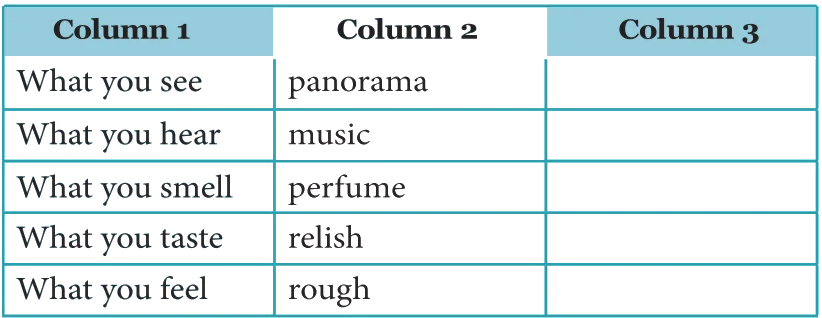
I. Sensory words are descriptive — they describe how we experience the world: how we see, hear, smell, taste or feel something.
Complete the following table with sensory words from the text in Column 2 for the five senses in Column 1. Add new words in Column 3.
Answer:
| Column 1 | Column 2 | Column 3 |
|---|---|---|
| What you see | Panorama | vibrant, radiant |
| What you hear | Music | harmonic, echoing |
| What you smell | Perfume | fragrant, zesty |
| What you taste | Relish | sweet, tangy |
| What you feel | Rough | silky, prickly |
The words you have underlined are a combination of two verbs. In each of these sentences, ‘should’ is the modal verb (suggestion), and the second verb (divide, want, arise, behold) is the main verb.
Modal verbs are helping (auxiliary) verbs that express the mood, possibility, necessity, ability, permission or obligation of the main verb.
They are used with the base form of the main verb (without ‘to’).
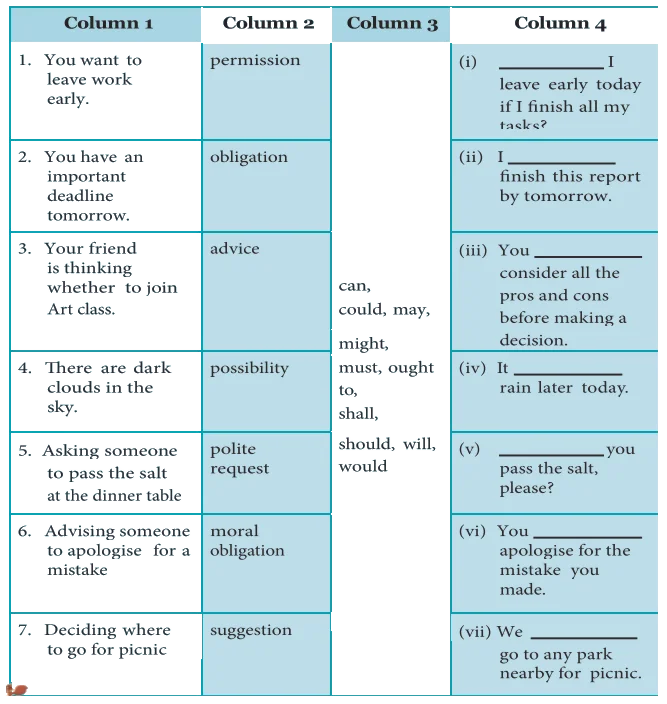
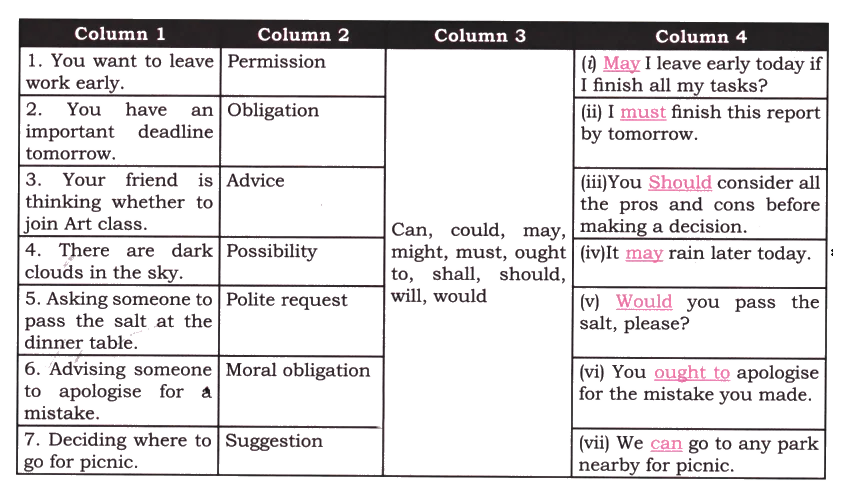
Some common modal verbs are: can (abili-ty/permission), could (polite request), may (permission/possibility), might (possibility), shall (suggestion/future), should (advice/ obligation), will (future/promise), must (necessity/strong obligation).
- I should divide the period into three parts.
- On the fist day, I should want to see…
- The next day I should arise with the dawn…
- I should behold with awe…
Answer:
- the should divide period into three parts.
- On the first day, I should want to see…
- The next day I should arise with the dawn…
- I should behold with awe…

1. You can learn a lot from this experience.
2. They might arrive late due to traffic.
3. She must finish her homework before dinner.
4. They ought to apologise for their mistake.
5. He would like to have some lassi, please.
Answer:
The functions they express are:
1. can – Ability
2. might – Possibility
3. must – Necessity
4. ought – Moral obligation
5. would – Polite request
Answer :
You will listen to a conversation between a mother and son. As you listen, select four true statements from 1-7 given below.
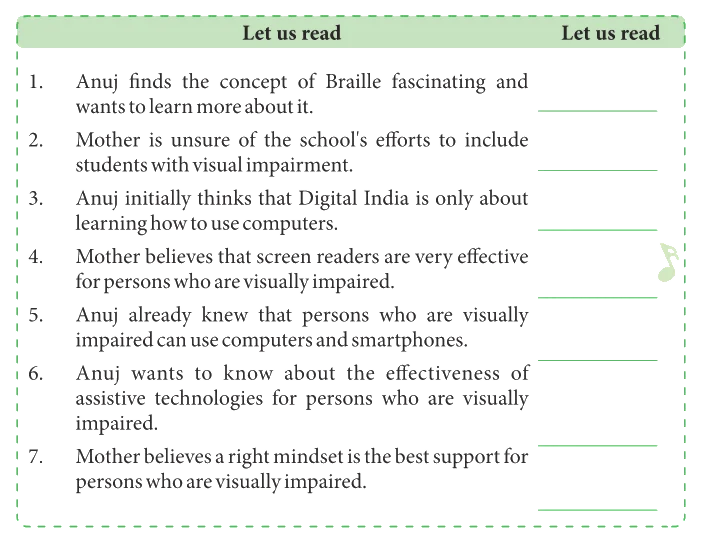
Answer:
1. → True – Reason: Because Anuj wants to know what is screen reader in computers and how they help blind people.
2. → False – Reason: Because mother is sure that the school has facilities to address the needs of the visually impaired.
3. → True – Reason: Because he said that Digital India is about being computer literate.
4. → True – Reason: Because mother explains Anuj what are assistive technologies.
5. → False – Reason: Because Anuj was unaware that visually impaired can use computers. His mother told him about that.
6. → False – Reason: Because her mother tells him what are assistive technologies when Anuj wanted to know about Digital India.
7. → True – Reason: Because the mother believes that computers can improve the quality of life of visually impaired.
Work in pairs. Take turns to speak for a minute on any one of the senses you value the most. Use the given prompts to frame your response before you speak.
- I value my sense of sight/sound/ touch/smell/taste the most because…
- One of my favourite experiences is…
- This is so because…
- I appreciate being able to see/hear/ touch / smell / taste…
- God forbid, if I were to lose the sense of sight/sound/touch/smell/taste, it would make me feel…
- I would not be able to…
- I thank God that I am able to see/ hear / touch / smell / taste.
Remember to
- speak clearly and confidently
- glance at your notes for reference rather than reading
- make eye contact
- use gestures if you wish to
- pronounce words clearly and avoid mumbling
- speak at a steady, moderate pace
Answer:
I value my sense of sight the most because it allows me to see the beauty of the world around me—the colours of flowers, the sparkle of sunlight on water, and the smiles of the people I love. One of my favourite experiences is watching the sunrise from a hilltop. This is so because the sky turns into a masterpiece of orange, pink, and gold, making me feel calm and hopeful. I appreciate being able to see the faces of my family and friends, their expressions telling me how they feel without needing words. God forbid, if I were to lose the sense of sight, it would make me feel scared and limited, as I wouldn’t be able to enjoy books, paintings, or the beauty of nature. I would not be able to see my surroundings and would need to rely more on other senses. I thank God that I am able to see the wonderful things life offers and cherish every moment I can see them.